
AI assisted development for life sciences software
Our engineers use AI in day to day software development. We also build agents and MCP servers that let models work inside real development environments. When the software is going into a life sciences or healthcare system, we help put the controls around that work.
How our engineers use it
Our engineers use Claude, GitHub Copilot, Codex and Lovable on client work that ships. They use the tools for code, tests, investigation and repetitive work. We give a model a defined task and the access it needs, then the engineer reviews the result and owns what goes into the product.
We are also building agents and MCP servers. We use agents for defined tasks. MCP servers give a model access to specific systems under rules we set beforehand. Each environment has its own idiosyncratic access rules. We have built several agents and MCP servers.
Where the tools fit in the workflow
Getting the tools running is usually straightforward. The harder part is deciding where they belong in the workflow, what the engineer needs to review, and how to use them without changing the way the team manages and ships software.
We can own the build, or work alongside the client's engineers on their codebase and within their constraints.
What the policy has to cover
A general AI coding policy does not cover the details that matter in life sciences software. Before the team uses the tools widely, the policy needs to say where they can be used, what gets reviewed, and what gets recorded.
Generated code inside a validated system
What happens to the evidence, change control and release record when part of the code was produced with AI assistance.
What the reviewer signs for
The reviewer remains responsible for the code. For a change to a validated system, the review may need to be exacting enough that another person can see what was checked and why it was accepted.
What the model is allowed to see
Patient data, client repositories and regulated records each need a clear rule for what the model may see. That rule belongs in the policy, where it can be reviewed and changed deliberately.
Where AI should not be used
Some work carries a regulatory obligation. The team responsible for the software decides where AI can be used and where it cannot.
SAIF
SAIF is our AI framework for software delivery. The policy is one part of it. The framework also covers the tooling, model choices, curated prompts, MCP connections, review process and the way AI fits into day to day development.
We built SAIF for companies that are still working out how to bring AI into engineering. Some clients already have their own rules, and we work within them. For teams that do not, SAIF gives them a starting point and the tooling to put those rules into practice, so AI adoption does not have to begin from scratch.
Testing
Test generation works well because the work repeats and the result can be checked by running the test. We use language models to draft test cases, find gaps in coverage, and keep the test suite consistent. The generated work stays inside the development and CI pipeline.
In a regulated context the evidence requirements stay the same. A generated test still needs a requirement, a version, a result and a record of the run so its provenance can be checked later. Our regulatory and validation practice runs that part.
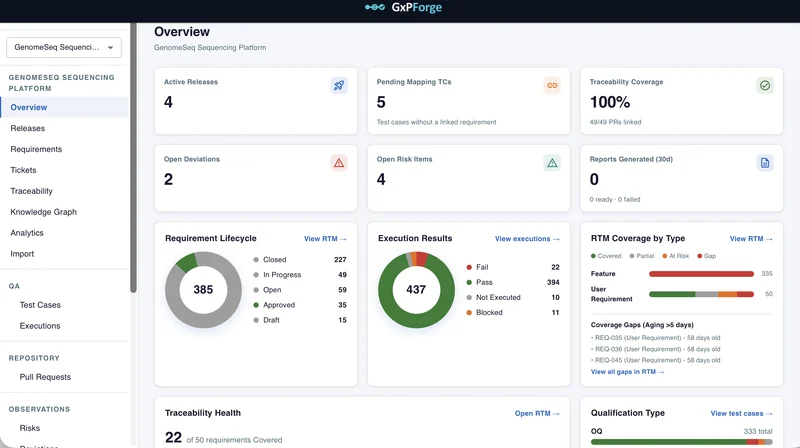
GXPFORGE, OUR OWN VALIDATION PLATFORM. REQUIREMENTS, TEST EXECUTIONS, COVERAGE AND DEVIATIONS IN ONE PLACE. READ ABOUT GXPFORGE
We run the build
We own the build, and AI is part of how the team develops the software.
We work with your engineers
We put the tooling, working practices and review standard on your codebase with your engineers.
Define the controls
We define the policy and the supporting tools, then set the rules for where AI can be used and what the reviewer is responsible for.
For AI built into the product itself, see AI for Life Sciences.
Questions people ask
Do you use AI to write our code?
Yes. Our engineers use these tools. They still review and own the code that ships. A validated system keeps the same evidence requirements when a model helps produce the first draft.
Can AI assisted development work in a regulated environment?
Yes. The rules need to be defined before the tools are used. They cover where AI can be used, what the reviewer is responsible for, what the model may see and what gets recorded.
What is SAIF?
SAIF is the policy we use for AI in software delivery. It covers the tools, where they can be used, and the review and record keeping around them.
What do you build with agents and MCP servers?
We use agents for defined tasks. MCP servers give a model access to specific systems under rules set in advance. We have built several agents and MCP servers.
Can you help our team adopt this?
Yes. We help with the tools, the working practices around them and the controls underneath.
Does our intellectual property go into a model?
We settle that before a tool is used. The policy names the permitted tools, the repositories they can access, and the agreements that apply.
Moving your engineering team to AI assisted development
We work with engineering teams putting AI into software delivery, including regulated environments.
Start a conversation