
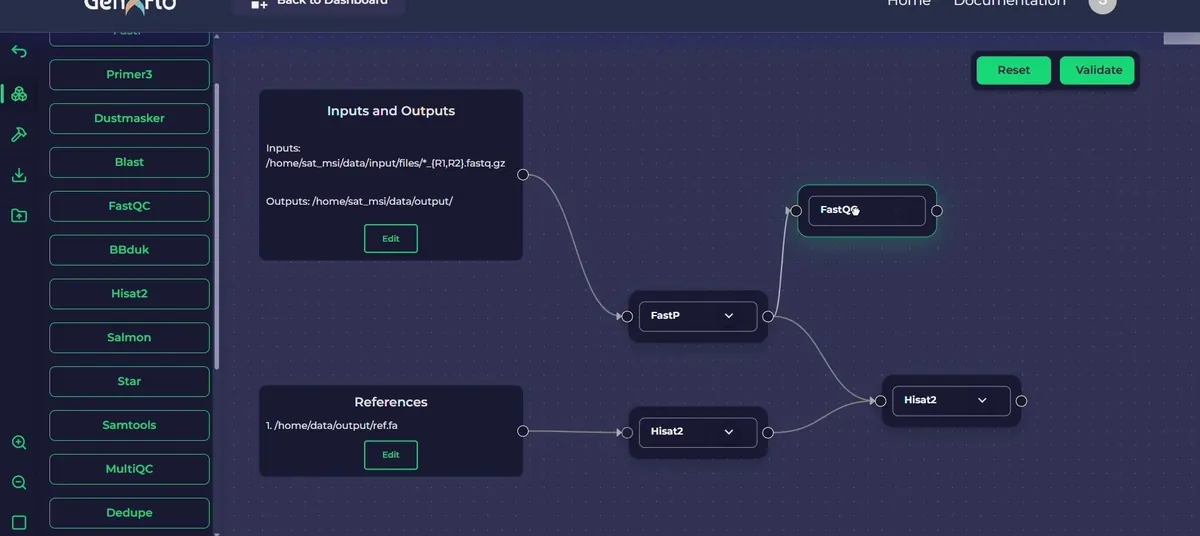
Scientists know what they want the pipeline to do. The bottleneck is often building it.
Many bioinformatics pipelines are still written by hand in Nextflow. Not every research team has someone available to spend weeks building and maintaining that code. GenXFlo is meant to reduce that dependency.
A researcher can build the workflow visually by adding and connecting steps. GenXFlo then creates the Nextflow code. The resulting workflow is standard Nextflow code and can run anywhere Nextflow is supported.
Visual pipeline design
Complex workflows built by dragging and connecting steps, with optimized Nextflow code generated from the design.
AI driven validation
An AI layer checks the workflow as it is built and flags errors before the pipeline is run. Measured against unchecked builds, that reduced mistakes by 40 percent.
Zero dependencies
Every pipeline runs in a built in, fully containerized environment with Dockerfiles included. There is no separate dependency setup for the user to work through.
Custom tool integration
Teams import their own bioinformatics tools and adapt scripting languages rather than starting from a blank workflow. It also gives new team members a simpler way to get started.
Genomics and bioinformatics teams that want to design, run, and share pipelines in minutes rather than days, without a dedicated pipeline engineer for every change.
Research groups scaling from a handful of workflows to many.
Teams that need reproducibility — containerized, version pinned pipelines — without building the infrastructure themselves.
GenXFlo is the tooling behind SequoiaAT's NGS pipeline development work. On a services engagement it means pipelines get built faster and handed over in a form the client's own team can maintain and extend visually.
NGS Pipeline Development →Offered as a tool deployed within an engagement or on its own. GenXFlo does not run live on this site.
End to end engineering for a custom genotyping assay design platform: Nextflow pipelines, NCBI reference databases, Angular and .NET. Time to market up 50 percent.
Read the case study →